
Travel · UK Guide 2026
Coordinate a Group Arriving on Different Services
JASOTO · Updated 5 November 2026 · 1,625 words
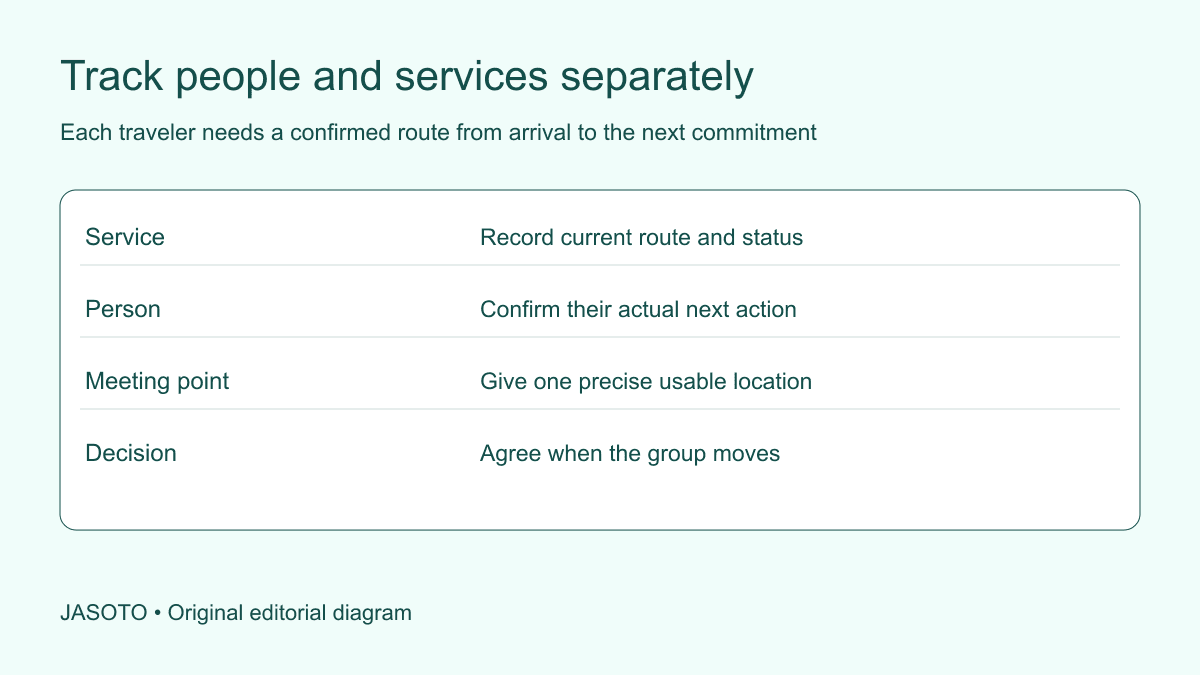
Original JASOTO editorial diagram. Its complete workflow is explained in the article; no actual customer outcome is depicted.
Coordinate a group arriving on different services by recording each arrival separately, choosing a precise meeting point and agreeing what happens when someone is delayed. Separate the service's expected arrival from the person's readiness to meet. Leaving a train, collecting a bag and reaching the agreed point can take time, and an updated service display does not establish that every traveler has reached the group.
This guide gives an original coordination method for UK business or community groups. National Rail provides live departure and arrival information for checking rail services. Use the appropriate operator for each actual journey and confirm current conditions. The group plan below adds contact ownership, waiting decisions and onward movement; it does not guarantee connections or assume every traveler can use the same route.
The practical answer
- Anchor arrivals in the next shared commitment.
- Keep service status separate from personal readiness.
- Choose a precise accessible meeting point.
- Agree the waiting and delayed-traveler plan.
Start with the group's next commitment
Identify why the group needs to meet and when it must leave for the next activity. A shared transfer, venue check-in and informal welcome create different constraints. Record the actual deadline and who can decide a change. A group should not be kept waiting indefinitely because the coordinator has never established whether the next appointment can move.
Confirm what is shared and what remains individual. Some travelers may make their own way to the venue while others use a common transfer. Do not assume everyone needs to gather at the station just because one person is arriving there. The plan should serve the group's actual purpose. A clear next commitment lets you decide which arrival differences matter and which can be handled through a separate joining instruction without inconveniencing people unnecessarily.
Record each journey as its own fact
Use a small arrival list containing the person's agreed name, service or route, arrival place, scheduled time and relevant contact method. Keep booking references and sensitive information in the appropriate private location. The coordinator usually needs enough information to identify the service and contact the traveler, rather than copies of every ticket and personal document.
Label proposed, booked and changed journeys clearly. A person considering a service should not appear as confirmed on the transfer list. If two people use the same train but leave through different exits or need different onward arrangements, keep their readiness separate. The list should support coordination without turning a shared transport reference into an assumption that everyone is physically together. Ask travelers to correct material details before the plan is finalized.
Choose a precise and usable meeting point
Describe a fixed point people can identify on arrival, with a text reference and an appropriate map or image where useful. Avoid “outside the station” when there are several exits. Check whether the point is suitable for the group and bags, and whether everyone can reach it through the relevant access route. Ask the station or venue about uncertainty instead of selecting a location from a distant map alone.
Distinguish the passenger meeting point from a vehicle pickup point. They may be different places, with a short guided move between them. A driver cannot necessarily wait where pedestrians naturally gather. Confirm the actual pickup arrangement with the provider and explain how the group reaches it. Keep the instructions simple enough that an unfamiliar traveler can follow them after a delayed or tiring journey, without needing to ask several strangers which side of the building the coordinator meant.
Give early arrivals a useful waiting plan
Tell early travelers where to go, who is present and what they may do before the group moves. If they can leave the meeting point temporarily, establish how they will receive the departure update and when they need to return. Avoid assuming a café, lounge or waiting room can accommodate the group without checking the relevant arrangement. A public location existing on a map does not establish capacity or permission for a planned gathering.
Keep the waiting plan proportionate to the trip. For a small business group, early arrivals may meet the coordinator and then receive a message when the others are ready. Another group may go directly to the venue. Record the actual choice rather than making everyone wait merely for the appearance of unity. The purpose is to give each traveler a clear next action while preserving the agreed onward commitment.
Separate live service status from personal status
Use current operator information to understand a delay, then confirm the traveler's situation through the agreed channel when necessary. National Rail's live tool can help identify a train's status, but it cannot tell you whether a particular person boarded, changed plans or is already at another entrance. Record “service delayed” separately from “traveler contacted and following revised plan”.
Ask travelers for concise updates that support a decision: current position, relevant change and whether they need help with the joining instruction. Avoid demanding continuous location sharing or a stream of screenshots when a short message is enough. If a person cannot respond immediately, use the agreed waiting and contact plan rather than interpreting silence as proof that they are safe at the venue or have abandoned the trip. Keep assumptions visible until the relevant fact is established.
Agree a waiting decision before the day
Set a decision point linked to the next commitment. Identify who decides whether the group waits, leaves in stages or changes the onward arrangement. Discuss plausible options with the responsible business or event contact beforehand. A coordinator should not have to choose between missing a venue slot and leaving a traveler without instructions while several people offer conflicting opinions at the pickup point.
The rule should describe the action and communication. For an invented group attending a workshop, the coordinator will contact the venue if a delayed service threatens the agreed departure. Depending on the confirmed response and actual transport terms, some participants may proceed while the delayed person receives a separate joining route. This is an illustrative decision structure, not a promise that splitting any booking is allowed. Check provider and venue arrangements before relying on an option.
Prepare a separate route for a delayed traveler
Give the traveler the venue address, host contact and the confirmed way to join if the group has already moved. Check whether they can use the proposed local service and whether any booking or cost decision is required. An instruction to “catch us up” can be unhelpful if it leaves the person choosing an unverified route to an unfamiliar site.
Keep the delayed route independent of information available only through the coordinator's device. Provide essential details in text and an appropriate offline form. If the group must change its own location, update the traveler directly through the agreed route. Do not assume a message in a busy group chat has been read and understood. Ask for a simple confirmation when the change materially affects where someone should go, while avoiding unnecessary repeated demands during their journey.
Coordinate bags, equipment and access needs
Identify practical requirements that affect onward movement, including the number and type of bags or equipment where relevant. Confirm the transport provider's actual capacity and conditions rather than assuming a nominal passenger count describes the whole requirement. Keep specialist handling and safety questions with appropriate competent people. The coordinator's role is to expose the need and obtain the correct arrangement.
Discuss individual access arrangements through a suitable private route and share only the practical information needed to make the group plan work. Do not publish personal circumstances to everyone in the arrival list. Check that the meeting point, waiting arrangement and onward vehicle or service connect into one usable route. A group can appear fully planned while the final move excludes someone because each component was checked independently without considering the handoff between them.
Maintain one current arrival board
Use one maintained list with a visible update time and a named coordinator. Record scheduled arrival, live change where relevant, traveler confirmation and current next action as separate fields. Keep a second person briefed if responsibility may transfer. A collection of unstructured messages can be useful evidence, but it is difficult to act on when nobody knows which message replaced the earlier plan.
Explore travel options for the shared and individual legs, confirming actual services with operators. For a local transfer discovered through business listings, agree the specific pickup and change process. If this coordination is a recurring task, describe it accurately in relevant roles, including the difference between maintaining the list and authorizing a changed booking. The tool can be simple as long as the responsibility and next action remain clear.
Close arrival coordination at the venue
Confirm that travelers have reached the agreed next stage through the appropriate host or group process. Do not mark everyone arrived merely because the last train is shown at the station. If someone follows a separate route, identify who expects them at the venue and how the coordinator learns that the handoff is complete. This prevents a traveler from remaining an unresolved name in one list while another person assumes they have already joined.
Afterwards, note the specific improvement for the next trip, such as a clearer meeting-point description or an earlier waiting decision. Preserve only the records appropriately needed and handle personal details through the normal arrangements. The rollback for confusion is to restore one confirmed meeting point, one coordinator and explicit instructions for each remaining traveler. Group arrival becomes manageable when service facts and personal readiness are distinct, with a practical route from every arrival to the next commitment.
Put the guide into practice
- Confirm journeys and coordinator ownership.
- Check the actual pickup arrangement.
- Provide a separate delayed joining route.
- Close the handoff at the venue.
Frequently asked questions
Should everyone wait for the final arrival?
Agree the waiting decision in advance according to the next commitment, actual transport arrangements and the travelers’ needs. Sometimes waiting is practical; another plan may allow people to proceed separately. Confirm the option rather than assuming a group booking can always be split.
Can a live train display replace asking the traveler?
It helps establish service status, but it does not confirm that a person boarded, reached the meeting point or changed their route. Keep service information and personal confirmation separate, using concise updates through the agreed contact channel.
What makes a good meeting-point instruction?
Name a fixed identifiable point, explain which exit or route reaches it and distinguish it from the vehicle pickup location. Check suitability for the group and relevant access needs. Essential details should remain usable if someone cannot open a live map.
Explore JASOTO tools
Discover providers and check support for your specific task.
Explore roles and responsibilities →Consider the practical responsibilities involved when recruiting or joining a team.
Plan work-related travel →Research a journey when joining, training or meeting colleagues in person.
Continue with JASOTO
Compare your next step
Discover UK businesses, compare services and request written quotes before making a decision.