
Travel · UK Guide 2026
Compare a Direct Journey With an Overnight Stop
JASOTO · Updated November 5, 2026 · 1,606 words
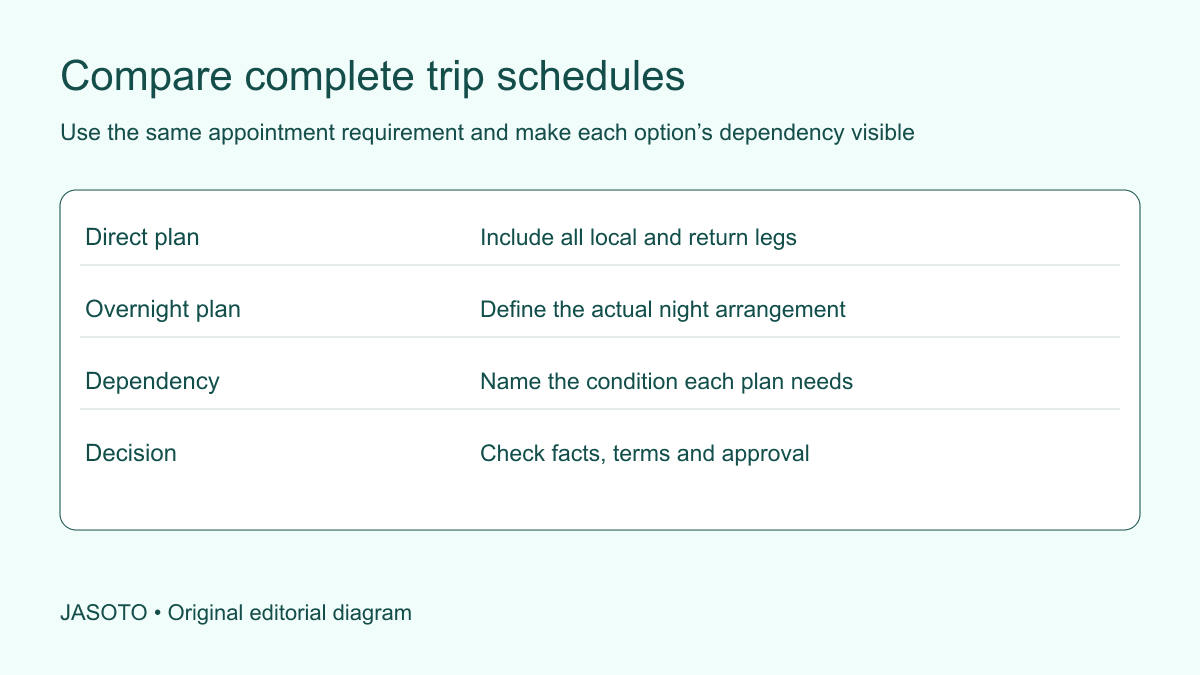
Original JASOTO editorial diagram. Its complete workflow is explained in the article; no actual customer outcome is depicted.
Compare a direct journey with an overnight stop by building both complete schedules around the same appointment requirement. Include departure preparation, local transfers, check-in or other access, rest opportunity, the meeting and the return. Then identify the unresolved dependency in each option. A shorter transport itinerary can still demand an impractical working day, while an overnight stop can add its own timing and booking problems.
This original guide supports US work-trip planning. Amtrak describes private-room options on some routes, showing that an overnight transport product is distinct from simply traveling late. Check the actual route, accommodation and booking conditions directly. The comparison below does not recommend a particular provider or assume an overnight option guarantees rest; it helps a traveler and business decision owner assess two genuinely workable schedules.
The practical answer
- Use equivalent door-to-door endpoints.
- Define the specific overnight arrangement.
- Compare complete schedules and dependencies.
- Keep booking availability separate from business approval.
Define the same appointment for both options
Confirm the actual venue, entrance, arrival requirement and task. Include any setup that must be completed before the discussion starts. Use that identical requirement for both schedules. Comparing a direct trip arriving at the station with an overnight option arriving ready in the meeting room would give one option an unfairly incomplete route. The comparison needs equivalent endpoints.
Ask the host about the expected finish and any planned activity afterwards. Record confirmed details separately from possible additions. The trip may look feasible only because the draft assumes the shortest meeting and no final handoff. If the appointment itself remains provisional, label both schedules accordingly. Research can still be useful, but neither option should become a confirmed business commitment until the relevant venue and timing facts are settled.
Build the direct option door to door
Start when the traveler needs to prepare and leave their actual starting point. Add the route to the main departure, transport, changes, final local leg and venue entry. Check current information for the relevant date and time. A service advertised as direct describes a transport connection, rather than the complete path from home to meeting room. Record each local dependency explicitly.
Include the return and its effect on the day's commitments. Ask what happens if the meeting runs longer than expected. A direct option should not be called feasible merely because there is a theoretical route that requires leaving before the essential discussion finishes. Keep the actual business purpose central. If the timetable does not fit, identify the specific conflict and the owner who can decide a different appointment or approved travel arrangement.
Define what overnight means in this plan
Separate traveling the previous day and staying at the destination from spending the night in transport. Those create different requirements and should not share one vague label. An overnight hotel stop needs actual arrival, check-in and morning movement. An overnight transport option needs the specific service and product to be checked, including what the traveler has actually booked and how the morning arrival connects to the appointment.
Amtrak's private-room information is one provider example of an overnight product with its own arrangements. Do not infer that every route or departure offers it, or that a seat booking provides the same setup. Keep the discussion factual and confirm availability directly. The comparison should describe the specific option under consideration, rather than attach an appealing idea of rest to any journey that happens to cross midnight.
Map the previous evening and meeting morning
For a destination overnight stop, record when you would reach the property, how entry works and what the morning departure requires. Ask the provider about the current arrangements relevant to your actual arrival. A late arrival can create an access dependency, while an early meeting can make a general breakfast or checkout assumption irrelevant. Verify the facts on which the schedule depends.
Keep the final mile to the meeting visible. Arriving in the city the night before does not eliminate local transport, equipment preparation or site entry. A property in a convenient-looking district may still require an awkward morning transfer. The overnight option should be tested as a complete route to the actual appointment, with any luggage collection or return movement included. This makes it comparable to the complete direct option rather than a room reservation considered in isolation.
Compare practical opportunity to prepare and recover
Describe what each schedule allows and requires without promising a personal outcome. One may permit a preparation period at a suitable place, while another depends on completing all work before departure. One may involve a very early start or a late return. The traveler should assess these facts in relation to their circumstances and responsibilities, rather than accept a universal claim that a particular option will feel restful.
Avoid turning the comparison into a medical or productivity prediction. An overnight booking does not guarantee sleep, and a direct journey does not automatically make someone unable to work. Record the actual schedule, environment and task demands, then discuss material concerns through the appropriate business or support route. The decision should be informed by the traveler's real needs and the role's requirements, with personal details shared only where appropriate.
List the dependencies that could break each plan
For the direct option, identify the critical connection, pickup or arrival step. For the overnight option, identify the actual lodging or transport confirmation and morning route. Ask what happens if that dependency changes. A plan with fewer stages may still depend heavily on one early service, while an overnight stop may add a late property arrival that needs confirmation.
Use a simple statement for each option: “This works if these confirmed arrangements remain in place; this detail is still unresolved.” Avoid pretending the comparison eliminates uncertainty. Its value is to expose where the uncertainty sits. For an invented regional client visit, the direct option depends on a tight local transfer, while the prior-night option depends on a confirmed late arrival at the property. The decision owner can then address the actual risk instead of debating whether overnight travel is generally better.
Compare complete costs and actual conditions
Collect current quotes using the same dates, traveler and relevant service assumptions. Include the categories that genuinely apply, such as local transfers, accommodation or equipment movement. Check the actual booking terms through the provider. Do not treat a search result's headline price as the whole cost or assume that a more expensive option has more useful change conditions.
Keep business approval separate from provider availability. A suitable room or service being offered does not establish permission to book it for work. Identify who approves the choice and which change would require another decision. This guide does not give financial or contractual advice; the comparison should point to the current facts and questions. If a term is unclear, obtain clarification before making a commitment rather than filling the uncertainty with a remembered rule from another provider.
Test the return and the next day's commitments
Include what happens after the appointment and any obligations that affect the following day. A direct return may arrive late, while another arrangement may require an additional night or a different working pattern. Do not compare only the outward journey because it is the most visible part of reaching the meeting. The business decision concerns the complete trip and its actual use of time and resources.
Confirm any destination access or pickup that depends on a late arrival. Keep personal arrangements distinct from business approvals, while raising a material practical constraint early enough for discussion. If the schedule cannot support the essential commitments, ask which part can change. A useful comparison may reveal that neither proposed option is workable and that the appointment timing or format needs reconsideration. That is a meaningful result, rather than a failure to choose between two attractive labels.
Present the decision in a compact comparison
Summarize the two schedules with required departure, appointment readiness, return, critical dependency, current booking state and decision needed. Include the source and date of important checks. Avoid producing a numeric score that hides the one constraint that matters most to the traveler or business. A concise explanation of the tradeoff is often easier for an approver to review.
Explore travel options during research and confirm services directly with the relevant operators. For local support or a transfer discovered through business listings, verify the actual arrangement. If planning these choices is a recurring responsibility, describe the work and authority boundary accurately in relevant jobs. The planner can organize evidence while the business owner decides which commitment is appropriate. Keep the selected option distinct from alternatives that remain only research.
Recheck after the choice changes
If the venue, meeting time or main service changes, return to the affected schedule and its dependencies. An overnight stop chosen for one location may lose its practical benefit after the meeting moves. A direct route may become workable if the arrival requirement changes. Preserve the confirmed facts and revise the choice through the actual approval and provider process.
After the trip, record the specific planning lesson rather than a universal verdict about direct or overnight travel. Restore the last checked itinerary if an improvised edit creates confusion, then update the changed element. A useful comparison leaves you understanding both options as complete sequences: what each requires, which details are confirmed and where a decision remains. The appropriate plan is the one supported by the actual appointment, traveler needs and approved arrangements, rather than the one whose headline journey looks shortest.
Put the guide into practice
- Confirm the actual appointment requirement.
- Build both outward and return sequences.
- Verify current provider conditions.
- Record the approved choice and unresolved points.
Frequently asked questions
Is an overnight stop always less tiring?
Do not assume a particular outcome. Compare actual departure, arrival, accommodation or transport setup and the opportunity to prepare and rest. The traveler’s circumstances and the task matter, and an overnight booking introduces its own access and morning-route dependencies.
Does a direct service mean there are no transfers?
It describes the relevant transport connection. You may still need travel to the departure point and a local route to the meeting entrance. Include those stages and the return before deciding that the complete trip is simple or feasible.
What if neither option fits the appointment?
Identify the exact conflict and ask the responsible business owner or host what can change. Another time, format or approved itinerary may need consideration. Do not force the comparison to select a plan that depends on an unconfirmed or impossible arrival.
Explore JASOTO tools
Discover providers and check support for your specific task.
Explore roles and responsibilities →Consider the practical responsibilities involved when recruiting or joining a team.
Plan work-related travel →Research a journey when joining, training or meeting colleagues in person.
Continue with JASOTO
Compare your next step
Discover UK businesses, compare services and request written quotes before making a decision.