
Travel · UK Guide 2026
Check the Address Before Booking a Station Transfer
JASOTO · Updated 5 November 2026 · 1,617 words
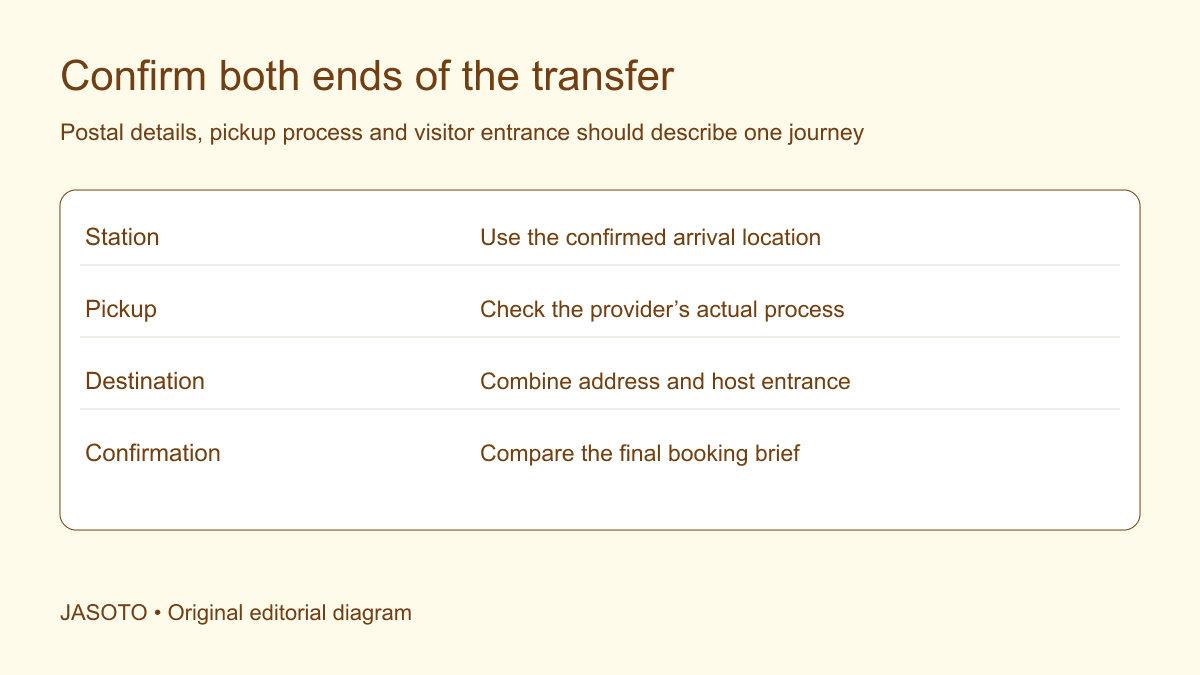
Original JASOTO editorial diagram. Its complete workflow is explained in the article; no actual customer outcome is depicted.
Before booking a station transfer, confirm both the exact station pickup and the destination entrance with the people responsible for them. Send the provider the full address, relevant building or unit, contact and practical arrival requirement. A postcode helps identify a postal address, but it does not establish which gate, door or reception a passenger should use.
This original guide is for UK transfers to meetings, offices or other appointments. Royal Mail's address finder supports checking postal details, and National Rail station pages provide station and transport-link information where available. Use those sources for their proper purpose, then confirm the actual pickup and destination access with the provider and host. The booking should describe a checked journey rather than a guess assembled from a map pin.
The practical answer
- Check the full station and destination identity.
- Separate postal address from visitor entrance.
- Confirm the provider’s pickup process.
- Review the final booking against the host instruction.
Separate postal address from arrival instruction
Ask the host for the full address and the actual passenger arrival point. A registered office, delivery address and meeting entrance can differ. Record the building or unit and any relevant site name. If the sign outside uses another trading name, include the practical explanation the host approves. The driver and traveler need to recognize the destination without reconstructing the company's organizational history.
Keep the source visible in your planning note. A postal lookup can help check spelling or identify a full address, while the host confirms how visitors enter. Do not let one replace the other. If a search result conflicts with the invitation, ask the host to resolve it. Choosing whichever address produces the shortest fare leaves the essential destination question unanswered and can create an incorrect booking that looks precise because it contains a postcode.
Confirm the station, including similar names
Use the full station name and the relevant arrival service or route. A town can have more than one station, and a name remembered informally may omit a distinguishing word. Check the ticket or confirmed journey rather than relying on a calendar label written before booking. If the arrival station changes, review the transfer request before assuming the same pickup still applies.
National Rail's station information can help locate maps and transport-link details. Inspect the actual station source and ask the provider about its pickup process. The station's postal address alone may lead to a different side from the relevant exit or vehicle area. Keep passenger meeting point and vehicle pickup distinct where the service requires it. The traveler should know how they reach the confirmed provider arrangement after leaving the train.
Obtain the destination entrance from the host
Ask a specific question: which entrance should a passenger transfer use for this visit? Include the appointment purpose where it affects access. A host may normally direct employees through a staff gate while visitors need reception. The correct vehicle approach may also differ from the pedestrian route. Confirm the instruction rather than asking the driver to select a gate from a satellite image.
For an invented technology park visit, the postal address refers to the main site while the meeting takes place in a numbered building reached through visitor reception. The host supplies the approved arrival instruction and receiving contact. The booking passes that information to the provider. This does not require publishing private security detail; it requires enough authorized context to prevent a passenger being dropped at a service entrance with no way to contact the expected host.
Check the map against the written details
Use a map as a supporting view and compare it with the full address and host instruction. Look for a discrepancy in building name, road, site boundary or entrance side. Do not silently move a pin because another result looks more plausible. Ask the responsible source to clarify a material conflict and record which location is current.
Royal Mail notes that postcodes are not intended to pinpoint an exact geographical location. Treat that as a reason to keep the entrance instruction, not as a reason to abandon postal details. The full address and practical arrival description complement each other. If the site uses an additional location reference, confirm that both provider and host understand it and keep the ordinary address alongside it. The traveler should not depend on a single code that one participant cannot interpret.
Describe the arrival requirement accurately
Tell the provider whether the passenger needs to reach reception by a particular time or be ready in a room after entry. Give the confirmed appointment time and any practical setup requirement where relevant. Distinguish a requested arrival from a provider promise. Ask whether the proposed pickup and journey can support it under the actual service arrangement.
Avoid omitting a known access or equipment need to make the booking seem simpler. Describe what affects the vehicle or arrival process through an appropriate private route. The provider can then confirm suitability and any limitation. Keep specialist handling or assistance questions with the relevant competent service contact. A booking summary should show the actual request and response, rather than turn an unresolved practical requirement into a confident “all arranged” note.
Give the provider a concise booking brief
Prepare one current message containing pickup station, provider-confirmed meeting or pickup point, arrival service context, destination address, entrance, passenger requirements and contact route. Include the relevant date and local time. Keep sensitive reference or personal information limited to what the provider needs through its agreed channel. Do not forward an entire travel folder containing unrelated bookings merely to provide one station arrival.
Ask the provider to confirm the destination and pickup in its response. Keep that checked response available to the person traveling, alongside the host’s current arrival contact and any relevant local instruction. A generic acknowledgement may establish receipt of the request without answering the route question. Review the confirmation against the brief before treating it as complete. If the provider shortens the destination to a town name or a map pin, retain the full approved detail in the maintained record and clarify whether its operational booking contains the actual entrance instruction.
Check what happens if the train changes
Ask the provider how it handles an altered arrival, delayed service or changed station. Use its actual conditions and contact process. Do not assume it monitors every service or automatically changes the booking. Identify which update the traveler must send and when. A confirmed address does not make the transfer complete if nobody knows how a revised arrival affects the pickup.
Keep the response factual and appropriate to the service. For the technology park example, the provider asks for an update through its established channel if the arrival changes. The itinerary records that action and the actual booking reference privately. It does not invent unlimited waiting or a guaranteed substitute vehicle. The purpose is to make the handoff usable when the schedule shifts, with the traveler knowing which information the provider needs to decide the next step.
Verify the final confirmation before departure
Compare the provider's current booking with the host's current arrival instruction. Check date, station, passenger context, destination and entrance. Correct an error through the established route and ask for confirmation where appropriate. A phone conversation resolving a discrepancy should be reflected in the maintained record so the traveler does not later use an older screenshot containing the wrong address.
Give the traveler the essential details in a usable format. They should be able to identify the intended destination and contact the provider or host if dropped at an unfamiliar point. Keep a relevant offline copy where appropriate. A coordinator's accurate private notes cannot help someone standing outside a site unless the needed information has been passed to them. Test the final message from the traveler's perspective rather than assuming that forwarding the booking email supplies every practical instruction.
Keep discovery separate from confirmation
Use travel research to explore the surrounding journey, then verify actual operator and provider arrangements. A transfer service found through business listings remains a potential supplier until its suitability and booking are confirmed. Do not treat a directory address as proof that the service can perform the requested route or that a listed office is the passenger's meeting location.
If coordinating transfers is a recurring responsibility, describe the work accurately in relevant roles, including the distinction between collecting address facts and approving the booking. The host owns destination access information, the provider owns its pickup process and the business decision owner approves the commitment where required. A useful booking brief connects those responsibilities without expecting the traveler or driver to resolve every ambiguity alone on the day.
Recheck the address after a venue change
When the meeting moves, return to the full destination check. A new building on the same site may require another entrance or route, while a new town can change the whole service. Tell the provider which instruction replaces the old one and confirm any changed conditions through the appropriate process. Updating a calendar pin alone does not establish that the transfer booking has changed.
After the trip, note the specific detail that would improve the next brief, such as the required reception name or a confusing station exit. Keep the correction tied to the actual source. The rollback for a doubtful booking is to restore the last confirmed pickup and destination, then resolve the exact conflict before another commitment. A good address check leaves both traveler and provider describing the same journey, with enough detail to reach the person expecting the arrival.
Put the guide into practice
- Obtain the entrance from the host.
- Resolve map and address conflicts.
- Confirm update rules for changed arrivals.
- Give the traveler usable current details.
Frequently asked questions
Is a postcode sufficient for a transfer destination?
Include the full address and the host-confirmed entrance as well. A postcode supports postal identification but does not establish the precise gate or reception for the visit. Resolve a conflict between the invitation, map and provider booking before relying on the transfer.
Who should confirm the station pickup point?
Use the actual station information and the transfer provider’s current process. The passenger meeting location and vehicle pickup may differ. Give the traveler a clear route between them rather than assuming the station’s postal address describes the operational pickup.
What if the provider’s confirmation has a shortened address?
Compare it with the complete brief and clarify whether the actual booking includes the correct destination and entrance. Keep the current host instruction in the maintained record. A generic acknowledgement or town name may leave the important arrival detail unresolved.
Explore JASOTO tools
Discover providers and check support for your specific task.
Explore roles and responsibilities →Consider the practical responsibilities involved when recruiting or joining a team.
Plan work-related travel →Research a journey when joining, training or meeting colleagues in person.
Continue with JASOTO
Compare your next step
Discover UK businesses, compare services and request written quotes before making a decision.