
Travel · UK Guide 2026
Compare Accommodation by the Final Mile to a Meeting
JASOTO · Updated 5 November 2026 · 1,624 words
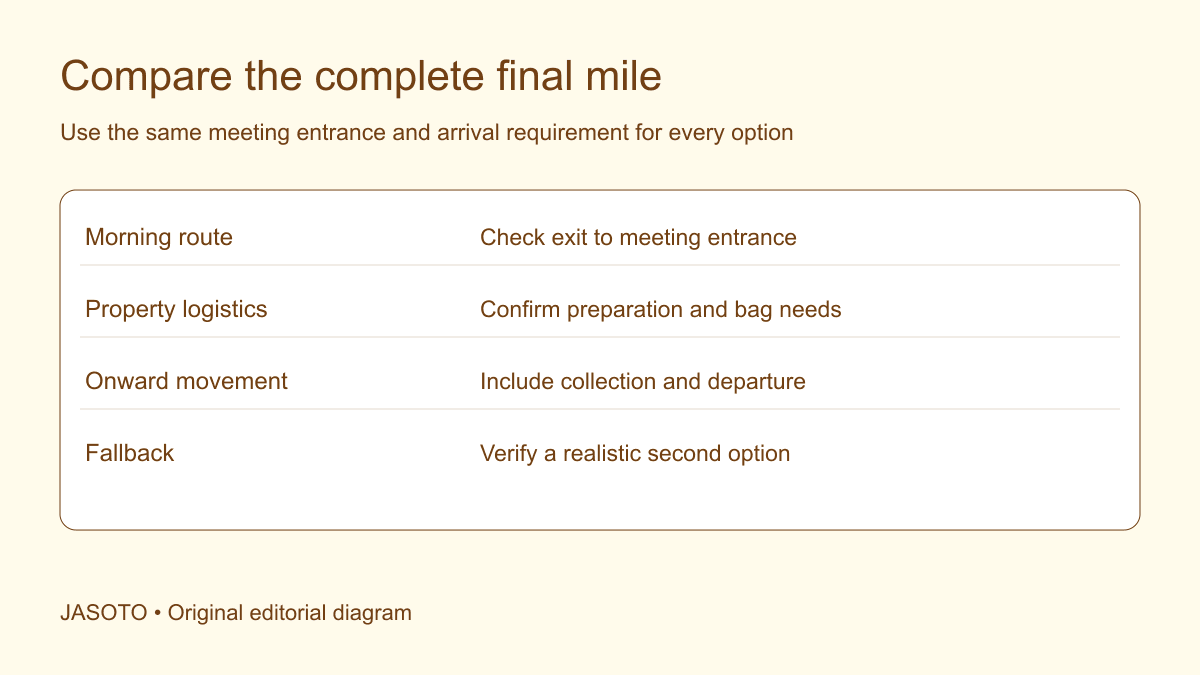
Original JASOTO editorial diagram. Its complete workflow is explained in the article; no actual customer outcome is depicted.
Compare accommodation by the complete journey from the property's exit to the meeting entrance at the time you need to arrive. Check the walking route, local transport, site access and what happens if the main option fails. A property described as central or near a station can still create an awkward final mile to the particular meeting you are attending.
This guide offers an original comparison method for UK work trips. Transport for London's planner provides dated arrival and departure searches with route preferences; use the appropriate official transport sources for other places. The comparison below helps organize your own research rather than recommending a particular property. Confirm current accommodation terms, facilities and transport directly before making a booking or business commitment.
The practical answer
- Anchor comparison in the actual meeting entrance.
- Check routes at the required date and time.
- Include property logistics and onward travel.
- Keep shortlist options separate from bookings.
Fix the meeting entrance and arrival requirement
Ask the host for the building, full address, entrance and person to ask for. Confirm whether you need to arrive before the scheduled discussion for reception or setup. Use that actual arrival requirement as the comparison's anchor. A hotel-to-town-centre route does not answer the question when the meeting is at a separate campus or an industrial estate beyond the centre.
Keep the meeting details visibly confirmed or pending. If the host has only proposed a venue, avoid comparing rooms as though that location is settled. Ask what is likely to change and when the venue will be confirmed. You can research provisional options, but record the uncertainty and avoid making an irreversible choice based on a map pin nobody has approved. A reliable destination reduces unnecessary work before accommodation research becomes detailed.
Compare the same complete route for each option
For every property, start at its actual guest exit and finish at the required meeting entrance. Include the walk to transport, any waiting and interchange, the final local leg and the route through the site. Use the same arrival requirement across all options so the comparison remains meaningful. A short walk quoted for one property and a station-to-station time quoted for another are not equivalent measures.
Record the source and date of the check. A property website may describe general proximity, while a transport planner describes a route for particular circumstances. Keep those statements separate. If a local section is uncertain, ask the host or provider rather than filling the gap with an assumed walking speed or an unavailable shuttle. The comparison should show what has been checked and which missing detail could materially change the choice.
Search for the actual meeting morning
Check the journey for the relevant date and arrival time. A convenient daytime route may differ for an early meeting, weekend appointment or local service change. Inspect the proposed route rather than copying its headline duration. For a London journey, TfL offers preferences that can help compare changes and walking; elsewhere use the relevant operator's equivalent information.
Look at what the departure implies for the rest of the morning. You may need time for preparation, checkout or collecting equipment before leaving the property. Those activities depend on the actual trip, so avoid assuming a universal allowance. A route that arrives on time only when every pre-departure task happens instantly is not a useful business plan. Keep essential preparation visible and ask the accommodation provider about any facility on which that preparation depends.
Examine the final walking section
Check whether the route is suitable for the person and what they must carry. A short distance can involve a complex crossing, an unfamiliar site entrance or a route different from the one shown by a general map. Ask the host about the appropriate pedestrian approach where necessary. Do not assume a postal address or vehicle entrance is the correct arrival point for a walking guest.
If access requirements matter, inspect the relevant route information and confirm uncertainties directly. A broad statement that a neighbourhood is accessible does not establish the complete journey through transport, pavement and building entry. Keep the question specific to the route and visit. The goal is to identify what needs confirmation before choosing a base, rather than rely on a general adjective that sounds reassuring but leaves the difficult segment unexplained.
Check property logistics that affect departure
Ask about the current arrangements you actually need: checkout, luggage handling, breakfast timing or a place to prepare materials, for example. Read the relevant booking conditions and distinguish included facilities from requests subject to confirmation. A late checkout or early room access should not become part of the itinerary merely because another property once offered it.
Connect each question to the meeting plan. If you need to leave a bag before an early appointment, establish where it will be and when you can retrieve it. If you need a quiet preparation period, confirm what arrangement is actually available rather than assuming a lobby or room can be used beyond the booking. Keep optional preferences separate from dependencies. A pleasant extra may matter to your choice, but it should not obscure the practical question that determines whether you can arrive prepared.
Compare simplicity alongside journey time
Look at the number of stages, the uncertainty at each handoff and the effect of a missed connection. A slightly longer published journey may be simpler, but test the actual options before concluding that it is more workable. The relevant tradeoff might be one direct local service versus several changes, or a longer walk versus dependence on a pickup. Describe the tradeoff in ordinary terms.
For an invented meeting trip, Property A appears closer in a straight line but requires a local connection that must be confirmed. Property B is farther away yet has a checked pedestrian route to the correct entrance. The comparison does not declare either property universally better. It identifies the unresolved transfer and asks whether the traveler can reasonably use the walking route. That specific evidence supports a decision without turning an illustrative example into a claim about real accommodation.
Include the end of the meeting day
Check the route from the meeting to the next commitment, including luggage collection where applicable. A convenient morning base can create backtracking after the appointment. If your return journey departs from another station or terminal, compare the whole sequence before booking. The accommodation decision can affect both the meeting arrival and the eventual departure from the area.
Ask the host about the expected finish and any uncertainty that matters to transport. Do not assume a meeting will end early enough for a tightly planned collection and connection. Keep a plausible later option where available and check its actual conditions. If the day does not fit, raise the conflict with the business decision owner. Choosing accommodation is part of coordinating commitments, rather than an isolated search for the shortest morning map distance.
Review costs and terms on comparable assumptions
List the current quoted accommodation cost and the transport or other relevant categories for each option. Verify amounts and terms directly, using the same dates and occupancy assumptions. Keep cancellation conditions, taxes or other required charges within the actual booking information. Avoid treating a search result's headline figure as the complete cost or assuming that a cheaper room necessarily produces a cheaper workable trip.
Record who can approve the business booking and what change requires another decision. This guide does not give financial advice or decide which terms are appropriate for you. It gives a way to make the comparison reviewable. An option with a lower room price but an unconfirmed local transfer should remain visibly uncertain. A decision maker can then evaluate the real tradeoff instead of approving a total that quietly leaves out the dependency most likely to change it.
Test a realistic fallback
Identify what you would do if the main local route becomes unavailable. Check whether an alternative exists at the relevant time and what it requires. An assumed taxi, shuttle or lift from the host is not a confirmed fallback. Ask the provider about the actual service or agree the arrangement with the relevant person before relying on it. Keep occasional emergency options distinct from a viable everyday route.
If no practical fallback exists, make that fact part of the choice and the arrival plan. You may select a different base, leave through another checked route or discuss the meeting time. Use travel research to explore possibilities and verify them with operators. For local services discovered through business listings, confirm the exact pickup and availability. The value of comparison lies in exposing the consequence of a failure, rather than adding a generic instruction to leave earlier without knowing what that solves.
Make a concise decision record
Summarize the confirmed route, departure implication, property dependencies, end-of-day movement and unresolved points for each serious option. Choose based on your actual requirements and approved business process. Keep the booking reference separate from the comparison and mark which option was selected. A property remaining on a shortlist should not accidentally appear in the itinerary as a reservation.
If the meeting venue changes, return to the final-mile check before assuming the original base is still useful. Restore the last confirmed plan and revise the affected route and booking decision through the proper process. When coordinating work travel is a regular responsibility, describe it accurately in relevant roles. A useful accommodation choice gives the traveler a feasible route to the actual meeting, with enough clarity about preparation and onward movement to understand the whole day's commitment.
Put the guide into practice
- Confirm the host’s arrival requirement.
- Compare equivalent door-to-door routes.
- Verify current accommodation terms.
- Record dependencies and the approved choice.
Frequently asked questions
Is the closest property usually the best choice?
Straight-line distance alone is insufficient. Compare the actual route to the correct entrance at the required arrival time, including transfers, access and what you carry. A nearby-looking property can depend on an unconfirmed connection, while another option may have a simpler checked route.
Should I include luggage collection in the comparison?
Yes, when it affects the meeting or onward journey. Confirm the actual storage or collection arrangement and include the time and backtracking involved. Do not assume the property will hold a bag or provide late access unless the relevant arrangement is confirmed.
What if the meeting venue is still provisional?
Label accommodation research as provisional and record which detail could change the choice. Ask when the venue will be confirmed and check booking terms before committing. Reassess the final mile once the actual entrance and arrival requirement are established.
Explore JASOTO tools
Discover providers and check support for your specific task.
Explore roles and responsibilities →Consider the practical responsibilities involved when recruiting or joining a team.
Plan work-related travel →Research a journey when joining, training or meeting colleagues in person.
Continue with JASOTO
Compare your next step
Discover UK businesses, compare services and request written quotes before making a decision.